We use cookies and analytics to improve your experience. You can opt out at any time.
Quick answer
No roof rack? This 2026 guide explains which car top carriers work safely without crossbars, how to install them, and what to avoid.
Disclosure: MyCargoRacks.com is reader-supported. When you buy through links on our site, we may earn an affiliate commission at no extra cost to you. Learn more
Price may vary. Prices and availability are subject to change.
Not every car has a roof rack. Not every car owner wants one. Maybe you drive a lease and can't drill anything. Maybe you need cargo space twice a year and can't justify a permanent rack. Maybe your car literally doesn't have mounting points.
I've been in all three situations. And each time, I found a way to haul gear on the roof without a rack. These aren't perfect solutions — I'll be straight about the limitations — but they work when you need them.
Three approaches actually hold up in the real world. Soft rooftop bags, vacuum-mount systems, and foam block carriers. Each one fills a different niche. Here's what I've learned using all three.
This is the solution for 80% of people reading this article. A padded bag that sits directly on your roof, secured by straps that run through your door frames or hook to your door jambs.
I've used soft bags on a 2018 Civic, a 2020 Camry, and a rented Hyundai Tucson that had rails but no crossbars. They worked on all three. Not elegantly. But they worked.
The strap-through-door method is simple. You open all four doors, lay the straps across the roof over the bag, feed the ends inside the door frames, close the doors on the straps, and tighten from inside or through the windows. The door seals clamp down on the straps and hold everything in place.
Does this damage the door seals? After dozens of uses, I haven't seen meaningful wear. The seals are designed to compress against the door frame. A flat nylon strap isn't dramatically different from the seal's normal job. That said, I avoid the thicker ratchet-strap style buckles against the seals — those can leave marks. Flat webbing straps only.
Here's where I get real. A soft bag strapped through door frames is not as secure as a hardshell box bolted to crossbars. It just isn't.
A soft bag strapped through door frames is not as secure as a hardshell box bolted to crossbars. It just isn't.
I keep my speed under 65 mph with a rooftop bag. I stop every hour for the first few hours to check strap tension. Straps stretch as they settle. If you set them at 70 mph tension and hit the highway, they'll be loose by mile 50.
For long highway trips at high speeds, a rooftop bag is a compromise. It works. People do it constantly. But you need to pay attention to it in a way you don't with a bolted-down rack system.
Also: wind noise is real. A soft bag creates turbulence your car wasn't designed for. You'll hear it. Keeping the bag centered and as low-profile as possible helps. Overstuffing it into a tall dome shape makes it worse.
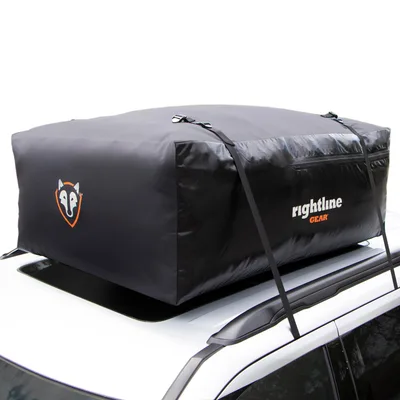
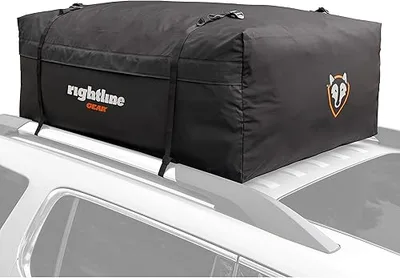
For most people the Rightline Gear Sport 3 is the one to get. Around $119 buys 18 cubic feet, welded seams, wide door-frame straps, and a bag that packs down flat when the trip is over — and it is the most-sold no-rack bag out there for good reason. It handles fair-weather and light-rain trips without drama.
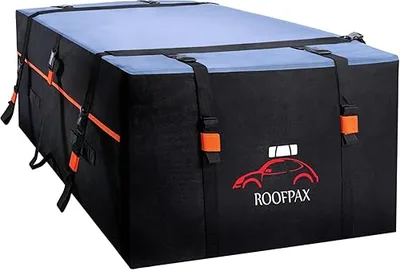
If your gear absolutely cannot get wet, step up to the Rightline Gear Range 3 (around $149) — same no-rack straps, but heavy-duty welded waterproof construction, and the one to trust through sustained heavy rain. And if you just want the cheapest way onto the roof, the RoofPax Cargo Bag ($59) gets you 15 cubic feet for occasional hauls, as long as you keep it out of constant UV.
Price may vary.
This is the option that makes people nervous. Suction cups holding gear to your roof at highway speed. I was skeptical too. Then I tried one.
The SeaSucker Monkey Bar system uses vacuum-mount pads that create 210 lbs of pull force per cup. The system uses multiple cups per mount point, and the total holding force is genuinely impressive. I've seen these hold bikes at 80+ mph on a track day (not that I'd recommend that on public roads).
Each mount has a hand pump that evacuates air from a large rubber cup pressed against your roof. A vacuum gauge on each cup tells you the seal status. You pump until the gauge reads green, and the cup is stuck to your roof with serious force.
The cups leave zero marks on clean paint. I've used them on both clear-coated and matte-finish vehicles with no issues. You do need a clean, smooth surface — textured roofs, deep panel gaps, and heavy curves won't seal properly.
Vacuum mounts need maintenance. The seals degrade over time. UV exposure, temperature swings, and dirt all reduce the holding force. Check the vacuum gauge every time you stop. Re-pump if the gauge drops from green. Replace the cups when they start losing vacuum quickly.
I also wouldn't use vacuum mounts in extreme cold. Below about 20°F, the rubber compounds stiffen and the seal quality drops noticeably. Summer and shoulder seasons only for me.
Price is the other barrier. A SeaSucker setup for a pair of crossbars runs $400-600. That's approaching the cost of a permanent rack system. It makes sense for specific use cases — pristine cars you don't want to drill, track cars, vehicles with unusual roof profiles — but it's not a budget solution.
Old school. Cheap. Limited. But still useful for one specific thing: carrying long items like surfboards, SUPs, kayaks, and lumber on a car without a rack.
Foam blocks sit on your roof. The item sits on the foam blocks. Straps go over the item and through the door frames, plus bow and stern lines to the bumpers. That's it. No mounting hardware. No suction cups. Just foam, straps, and hope.
Okay, it's more secure than that. I've hauled kayaks on foam blocks many times. The key is proper bow and stern lines. The foam and door straps handle vertical load. The bow and stern lines prevent front-to-back sliding. Without all three elements, the system fails.
A set of foam blocks with straps costs $20-40. As a once-a-season solution for getting a kayak to the lake, they're perfect. As a regular cargo solution, they're not the answer.
I'm not going to pretend these rackless solutions are as good as an actual rack. They're compromises. Good compromises for the right situations, but compromises.
If you're hauling rooftop cargo more than 5-6 times a year, the math starts favoring a real rack system. A basic Thule or Yakima setup with fit kit runs $300-500 depending on your vehicle. That buys you higher weight capacity, proper aerodynamic bars, and the ability to mount any accessory — cargo boxes, bike racks, ski carriers, whatever you need.
For lease vehicles, many rack systems install with no drilling using factory mounting points (door frames, fixed points, raised rails). They come off clean when you return the car.
No roof rack doesn't mean no rooftop cargo. A soft bag with door-frame straps handles most occasional hauling needs. Vacuum mounts serve niche applications well. Foam blocks get boats to the water cheaply.
Pick the right tool for your situation. If you're doing a once-a-year camping trip, the $130 rooftop bag is all you need. If you're a competitive kayaker loading up every weekend, stop messing with foam blocks and invest in a proper rack.
I've never had a load come loose, and that's because I stop and check. Every single time.
And whatever method you use: check your straps constantly for the first few trips until you trust your setup. I've never had a load come loose, and that's because I stop and check. Every single time.
---Best Overall Rightline Gear Sport 3 Car Top Carrier | Budget Pick RoofPax Cargo Bag 15 cu ft | Most Weatherproof Rightline Gear Range 3 Car Top Carrier | |
|---|---|---|---|
| Weight Capacity | 100.0 | 100.0 | 100.0 |
| Weight | 8.6 | 5.5 | 9.0 |
| Length | 48.0 | 43.3 | 48.0 |
| Width | 36.0 | 31.5 | 36.0 |
| Height | 18.0 | 19.8 | 18.0 |
| Material | Fabric | Fabric | Fabric |
| Mounting | Roof Crossbar | Roof Crossbar | Roof Crossbar |
| Installation | Tool Free | Tool Free | Tool Free |
| Noise Rating | Moderate | Moderate | Moderate |
| Security | None | None | None |
| Value Score | 88 | 91 | 88 |
| Ease of Use | 86 | 86 | 86 |
| Build Quality | 73 | 68 | 73 |
| Foldable | No | No | No |
| Score | 86/100 | 85/100 | 86/100 |
| Check Price | Check Price | Check Price |
Rightline Gear Sport 3 Car Top Carrier
RoofPax Cargo Bag 15 cu ft
Rightline Gear Range 3 Car Top Carrier
Products Mentioned
Related articles
Hand-picked price drops on the racks and carriers we actually recommend. Updated weekly.
Shop today's deals →Newsletter
Get the best rack deals in your inbox
Weekly picks, price drops, and honest reviews. No spam.
Disclosure: MyCargoRacks.com is reader-supported. When you buy through links on our site, we may earn an affiliate commission at no extra cost to you. Learn more