Quick answer
Discover the ultimate snowmobile ski and snowboard racks for your winter getaways. Our top picks ensure your gear stays secure and accessible.
Disclosure: MyCargoRacks.com is reader-supported. When you buy through links on our site, we may earn an affiliate commission at no extra cost to you. Learn more
Price may vary. Prices and availability are subject to change.
Mounting a ski or snowboard rack on a snowmobile isn't the same engineering challenge as mounting one on a car roof — and it shouldn't be treated as one. The forces are different. The mounting surfaces are different. The environmental conditions are exponentially harsher. Yet most online guides treat snowmobile-mounted ski carriers as an afterthought, lumping them in with general ski rack advice. That does a disservice to anyone who actually needs to haul gear on a sled.
I've spent over 30 years in automotive and vehicle engineering, and while snowmobiles aren't cars, the physics of mounting, vibration, and load-bearing don't change just because you've swapped asphalt for snow. Let me walk through what actually works, why certain designs fail, and which products in 2026 deserve your money.
A car-mounted ski rack lives a relatively comfortable life. It sits on rigid metal crossbars bolted to a steel roof. It experiences wind load and some vibration, but the forces are predictable and well-managed. A snowmobile-mounted rack faces an entirely different reality:
A mounting system that relies on friction or compression will loosen over the course of a single ride.
The tunnel is the strongest structural element at the rear of a snowmobile. Tunnel-mounted ski carriers bolt directly to the tunnel through existing or drilled holes. This creates the most rigid connection, but it also means you're putting load on a structural member — and depending on the sled, potentially voiding warranty coverage if you modify the tunnel.
Engineering note: The tunnel is designed to handle the downward and rearward loads from the track suspension. Adding a lateral load (from skis mounted perpendicular to the direction of travel) introduces a force vector the tunnel wasn't specifically designed for. For one or two pairs of skis, this is well within the tunnel's capacity. For heavier loads or aggressive riding, use through-bolted mounts rather than clamps — the shear strength of a bolt beats the friction of a clamp in every high-vibration scenario.
Many touring and utility snowmobiles have a rear luggage rack — a flat or slightly raised platform behind the seat. Ski carriers that attach to this rack use clamps or U-bolts to grip the rack's tubing. This is the most accessible mounting location and doesn't require drilling or permanent modification.
The limitation: Rear racks are designed for distributed loads (a gear bag, a fuel container) — not concentrated point loads from a clamped ski carrier. If your rack tubing is thin-wall steel or aluminum, over-tightening a clamp can crush it. Use rubber-lined clamps that distribute pressure across a wider area of the tube surface.
Some sleds — particularly Ski-Doo's LinQ system and Polaris's Lock & Ride system — have proprietary accessory attachment points. These are purpose-designed for modular accessories and offer the cleanest installation. The downside: you're locked into that manufacturer's accessory ecosystem, and the carriers are typically more expensive.
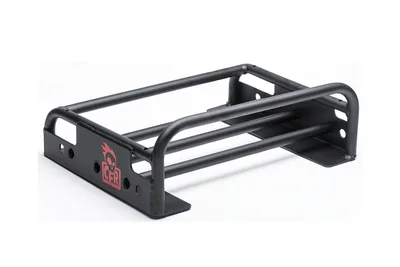
Cheetah Factory Racing (CFR) has built their reputation in the backcountry snowmobile community, and their tunnel-mount ski rack is the standard against which I judge everything else. The mounting plate bolts directly to the tunnel with stainless steel hardware. The ski clamp uses a spring-loaded latch that's operable with gloves — a design detail that sounds minor until you've tried fumbling with a thumbscrew at -15°F with thick gloves on.
What makes it work: The rack positions skis parallel to the sled's direction of travel, which is aerodynamically correct and minimizes lateral force on the tunnel. The latch mechanism has positive engagement — you feel and hear it lock — which gives confidence that vibration hasn't loosened anything during a ride.
What to know: CFR racks are tunnel-specific. You need to verify compatibility with your sled's tunnel width and bolt pattern. They're also premium-priced at $130–$150. For a product that holds your skis at speed through rough terrain, I consider that money well spent.
Price may vary.
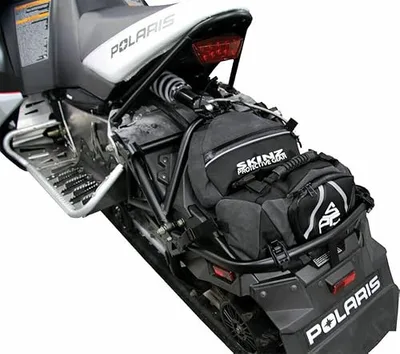
Snowboards present a different challenge than skis — they're wider, heavier individually, and have bindings that protrude significantly. The Skinz Protective Gear snowboard carrier mounts to the tunnel or rear rack and uses a cradle design that supports the board flat, with straps securing it over the bindings.
What makes it work: The flat cradle distributes the snowboard's weight across a wider area, reducing point loads. The strap routing goes over the bindings — not around them — which means you're not relying on the board's width alone for retention. The materials are UV-stabilized nylon and stainless steel, both of which hold up in cold and wet conditions far better than uncoated carbon steel or basic nylon.
What to know: Verify your board width fits the cradle. Most accommodate boards up to 12 inches wide, which covers the vast majority of all-mountain and powder boards. Price is approximately $130–$150.
Price may vary.
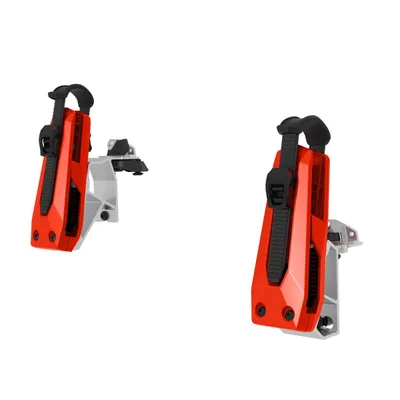
If you ride a Ski-Doo with the LinQ accessory system, the factory ski rack is the cleanest solution available. It locks into the LinQ mounting points without tools and releases just as quickly. No drilling, no clamps, no potential damage to the tunnel.
What makes it work: The LinQ system was engineered as a unified accessory platform. The mounting points are structural, with defined load ratings. The ski rack itself is injection-molded with reinforcement ribs — it's designed specifically for this use case, not adapted from a car product.
What to know: It only works with Ski-Doo LinQ-compatible sleds. And at $160–$180 from the dealer, you're paying a premium for the OEM ecosystem. That said, the fit, finish, and engineering confidence are worth it if your sled supports it.
Price may vary.
| Feature | CFR Mountain Rack Universal | Skinz Rear Bumper Rack | Ski-Doo LinQ Ski/Snowboard Rack |
|---|---|---|---|
| Mounting | Bolt-through tunnel | Rear bumper / tunnel | LinQ accessory rail |
| Best For | Skis (backcountry riders) | Snowboards | Ski-Doo owners |
| Installation | Bolt-on (permanent) | Bolt-on or clamp | Tool-free quick-connect |
| Glove-Friendly | Yes (spring-loaded latch) | Yes (strap system) | Yes (LinQ lever) |
| Price Range | $130–$150 | $130–$150 | $160–$180 |
| Compatibility | Universal (verify tunnel width) | Most sleds with bumper/tunnel | Ski-Doo LinQ only |
Several aftermarket manufacturers sell universal tunnel clamp ski racks in the $50–$80 range. These use adjustable clamps that grip the tunnel and a simple cradle or loop to hold skis. They work. They're not elegant, and the clamp quality varies wildly by manufacturer.
My recommendation: If you go this route, spend the extra $10–$15 to get stainless steel hardware and replace any carbon steel bolts with stainless equivalents. Carbon steel rusts aggressively in wet, salty snow conditions. A rusted bolt head that rounds off when you try to remove it in the field is a problem you don't need.
If you're reading this and thinking "can't I just strap a car ski rack to my sled?" — no. Here's why:
Car ski racks are engineered for crossbar mounting, clamping pressure, and aerodynamic loads at highway speed. They're designed around T-slot or round/square crossbar profiles. A snowmobile has none of these. Car rack clamps won't fit snowmobile tunnel dimensions. The rubber pads in car racks will crack and lose grip at -20°F. And the anti-theft locking mechanisms on car racks — nice for a parking lot — are useless in the backcountry and add weight and complexity you don't need.
Use snowmobile-specific racks. They exist because the engineering requirements are genuinely different.
Any rack mounted on a snowmobile requires more maintenance attention than a car-mounted rack. Here's the minimum protocol:
Carrying skis and snowboards on a snowmobile is a solved problem, but only if you use the right equipment for the environment. The CFR tunnel-mount rack is my top recommendation for most riders — it's secure, purpose-built, and proven in the backcountry community. For Ski-Doo LinQ owners, the factory rack is the obvious choice. For budget setups, a universal tunnel clamp rack works if you upgrade the hardware to stainless steel and commit to regular maintenance.
Whatever you choose, remember that a snowmobile subjects every mounted accessory to vibration, cold, and moisture levels that would destroy most car-oriented products. Buy snowmobile-specific, bolt rather than clamp when possible, and inspect your hardware regularly. For a broader look at how ski and snowboard rack systems work across all vehicle types, our expert guide to ski rack engineering covers the fundamentals.
Best Overall CFR Mountain Rack Universal Tunnel Rack | Best for Snowboards Skinz Rear Bumper Rack (Polaris) | Best Modular System Ski-Doo LinQ Ski/Snowboard Rack | |
|---|---|---|---|
| Weight Capacity | 100.0 | 100.0 | 100.0 |
| Weight | 6.0 | 4.0 | 5.0 |
| Material | Aluminum | Nylon | Aluminum |
| Mounting | Snowmobile Tunnel | Snowmobile Tunnel | Snowmobile Tunnel |
| Installation | Basic Tools | Basic Tools | Basic Tools |
| Noise Rating | Minimal | Minimal | Minimal |
| Value Score | 94 | 90 | 90 |
| Ease of Use | 92 | 88 | 88 |
| Build Quality | 80 | 78 | 84 |
| Score | 93/100 | 88/100 | 90/100 |
| Check Price | Check Price | Check Price |
CFR Mountain Rack Universal Tunnel Rack
Skinz Rear Bumper Rack (Polaris)
Ski-Doo LinQ Ski/Snowboard Rack
Products Mentioned
Related articles
Hand-picked price drops on the racks and carriers we actually recommend. Updated weekly.
Shop today's deals →Newsletter
Get the best rack deals in your inbox
Weekly picks, price drops, and honest reviews. No spam.
Disclosure: MyCargoRacks.com is reader-supported. When you buy through links on our site, we may earn an affiliate commission at no extra cost to you. Learn more