Is Your Hitch Cargo Carrier Legal in 2026? Don't Get Caught
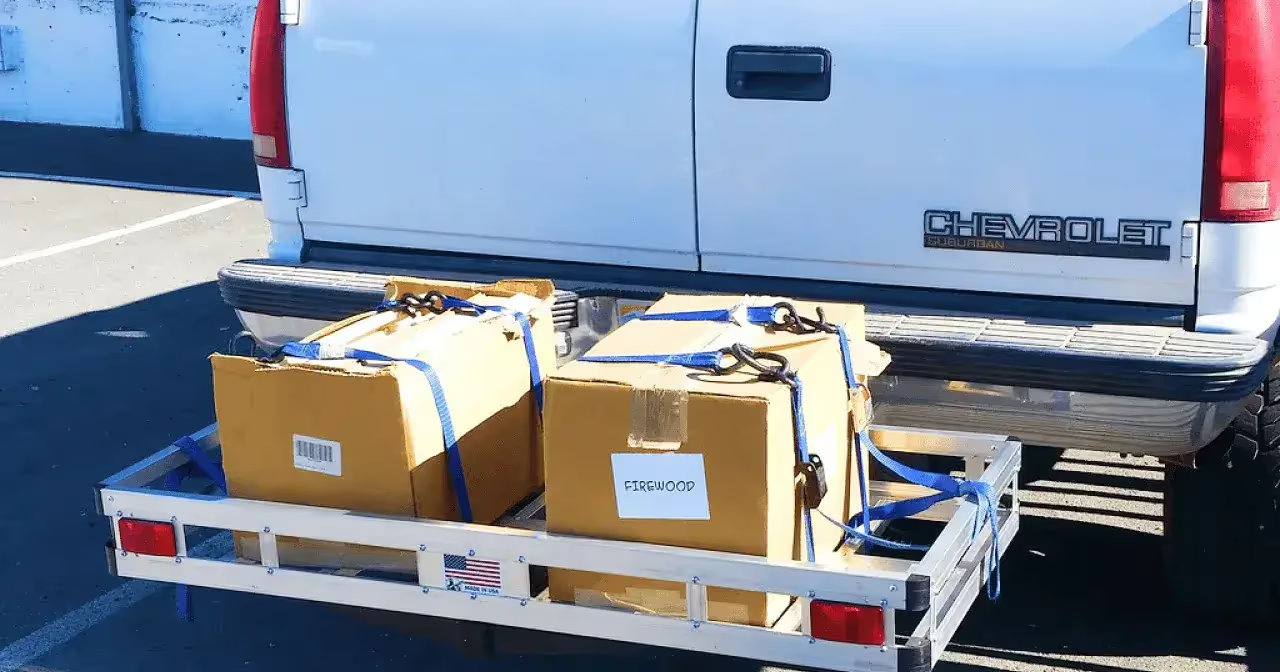
I got pulled over on I-95 outside Jacksonville in 2019. A loaded hitch cargo carrier was blocking my license plate. The officer was polite. The ticket was $175. The lesson was permanent.
Hitch cargo carriers exist in a legal gray area that most people don't think about until they see blue lights. The carrier itself is legal. What it does to your plate visibility, tail light visibility, and rear overhang can make your vehicle illegal. And the rules vary by state in ways that will surprise you.
Here's what you actually need to know to stay legal, based on my experience, reader stories, and a lot of time reading state vehicle codes so you don't have to.
The Three Things That Get You Pulled Over
In years of talking to readers, forum members, and occasionally law enforcement officers at car shows, the same three issues come up every time:
1. License Plate Obstruction
This is number one by a mile. A loaded hitch carrier — whether it's a platform with stacked bins or an enclosed cargo box — almost always blocks the rear license plate. Every state in the US requires your rear plate to be visible. Period.
Some states specify the plate must be visible, illuminated, and unobstructed from specific angles. California Vehicle Code Section 5201 requires the plate to be clearly visible and "maintained in a condition so as to be clearly legible." New York Section 402 requires the plate to be "kept clean and in a condition so as to be easily readable."
A hitch carrier loaded with a cooler and two duffel bags? That plate is not visible, clean, or legible. You're in violation.
2. Tail Light and Turn Signal Obstruction
Same concept, less commonly enforced, but still on the books everywhere. If your loaded carrier blocks your brake lights, turn signals, or tail lights, you're violating every state's lighting requirements. This is also genuinely dangerous — the car behind you can't see you braking.
Enclosed hitch carriers are the worst offenders here. They sit right at tail light height and block everything. Platform carriers with tall loads have the same problem.
3. Rear Overhang
Most states limit how far a load can extend beyond the rear bumper. Common limits are 3-4 feet without a flag or marker, and some states have absolute maximums even with markers. A hitch carrier extends roughly 2 feet past the bumper when empty. Add cargo that hangs off the back edge and you can easily exceed overhang limits.
Texas allows 4 feet of rear overhang without a flag. California allows 4 feet. Florida allows 3 feet. If your loaded carrier extends more than that, you need a red flag (day) or red light (night) on the rearmost point — and even then, some states cap the total at specific lengths.
State-by-State Highlights
I can't cover all 50 states in detail, but here are the ones that come up most often in reader questions:
California
Strict. Plate must be clearly visible and legible at all times. Tail lights must be visible from 300 feet. Rear overhang over 4 feet requires a solid red or fluorescent orange flag at least 18 inches square. CHP officers are known to enforce these actively, especially on I-5 and US-101 during holiday weekends.
New York
Plate must be "conspicuously displayed" and "easily readable." Obstruction of plate is a moving violation. Tail lights must be visible from 1,000 feet. New York State Troopers have told readers they specifically watch for obscured plates on vehicles with cargo carriers.
Texas
Plate must be visible and legible. More lenient on enforcement in my experience, but the law is clear. Rear overhang is 4 feet without a flag. DPS officers have more leeway and I've heard from Texas readers who got warnings rather than tickets, but don't count on that.
Florida
Plate must be "clearly visible." Rear overhang limit is 3 feet without a flag — shorter than most states. Florida Highway Patrol is active on major routes and I-75 especially. Multiple readers have reported tickets for plate obstruction in Florida.
Canadian Provinces
Provincial rules vary but follow similar patterns. Ontario's Highway Traffic Act requires the plate to be "entirely unobstructed." British Columbia requires the plate to be "clearly visible." Quebec is similar. Fines tend to be higher than US equivalents.
What Actually Triggers a Stop
Here's what I've gathered from reader experiences and a few off-the-record conversations with officers:
An invisible plate is the primary trigger. Officers running plates as they drive behind you — which is routine — can't run what they can't read. That alone is enough to initiate a stop. It doesn't matter if you're driving perfectly.
An otherwise-legal carrier with visible plate rarely gets attention. If your plate is relocated to a visible position and your lights are unobstructed, officers generally don't care about the carrier itself. It's the consequences of the carrier — plate and light obstruction — that trigger enforcement.
Night driving with blocked tail lights is dangerous and gets noticed. If the car behind you has to guess when you're braking, you're creating a hazard. Officers see this from their patrol vehicles and will stop you for it.
How to Stay Legal: The Practical Solutions
License Plate Relocation
The single most important thing you can do. Move your plate to a visible position on or behind the carrier.
Option 1: Hitch plate mount. A bracket that slides into the same receiver as your carrier, positioning the plate below the cargo. Some carriers have integrated plate mounts. If yours doesn't, aftermarket brackets run $15-30 and take five minutes to install.
Option 2: Carrier-mounted plate bracket. A bracket that bolts to the back edge or frame of the carrier itself. Position the plate at the rearmost point where it's visible from behind. This is my preferred method because the plate moves with the carrier.
Option 3: Plate relocation bar. An extension bar that positions the plate below and behind the cargo area. More visible than options 1 and 2 in some configurations.
Whichever method you use, make sure the plate is illuminated at night. A small LED plate light ($10-15) wired into your trailer harness handles this. Without illumination, a relocated plate is still technically illegal after dark in most states.
Auxiliary Tail Lights
If your carrier blocks your factory tail lights — and most enclosed carriers do — you need auxiliary lights on the carrier itself.
A magnetic or bolt-on LED light bar is the standard solution. They wire into your 4-pin or 7-pin trailer harness and provide brake lights, turn signals, and running lights behind the cargo. Good ones cost $25-50 and install in under 30 minutes.
I use a TowSmart wireless LED light bar on my enclosed carrier. No wiring. Magnetic mount. Syncs to a transmitter that plugs into the trailer harness. It's not quite as bright as a wired setup, but it's convenient and has been reliable for two seasons.
Reflective Tape and Flags
I put reflective tape on every carrier I own, regardless of other lighting. A roll of DOT-rated reflective tape costs $8 and takes five minutes to apply. Red on the back, amber on the sides. It's cheap insurance for visibility and meets most states' reflector requirements.
For loads that extend past the carrier's rear edge, a red flag in daylight and a red light at night are required in most states. Keep a couple of flags in your cargo kit. They weigh nothing and cost nothing.
Real Stories From Readers
A reader in Oregon got pulled over for an obscured plate on I-84. No ticket — the officer gave a verbal warning and told him to relocate the plate before continuing. He bought a plate bracket at the next auto parts store. Total cost: $18 and a 15-minute detour.
A reader in Virginia wasn't as lucky. Ticket for plate obstruction, plus a secondary citation for obscured tail lights. Combined fines: over $200. His enclosed carrier completely blocked both plate and lights. He now runs a wired LED bar and a carrier-mounted plate bracket. He says the total cost of the legal setup was less than the tickets.
A reader in Ontario got a $110 CAD ticket for an obstructed plate at a RIDE check (random roadside inspection). The officer told him it was one of the most common violations they see on vehicles with hitch accessories.
The pattern is clear: the fix costs $30-50. The ticket costs $100-300. The math is simple.
The Pre-Trip Legality Check
Before every trip, I do a 30-second walk-around:
- Can I read my plate from 20 feet behind the vehicle? If not, reposition it.
- Can I see brake lights, turn signals, and tail lights from behind? Have someone press the brake and activate signals while you look. If not, add auxiliary lights.
- Does the load extend more than 3 feet past the bumper? If yes, add a flag.
- Is everything strapped down securely? Loose cargo that falls off your carrier is a separate legal issue in most states — and a safety hazard.
Thirty seconds. Every time. No exceptions.
Hitch cargo carriers are completely legal to use. The legality problems come from the secondary effects — blocked plates, obscured lights, excessive overhang. All of these are cheap and easy to solve if you address them before you hit the road.
Relocate your plate. Add auxiliary lights if needed. Check your setup before every trip. The total investment is under $50 for full compliance in every state.
If you're still shopping for a hitch carrier, check out our practical review of the best hitch cargo carriers for 2026 — I cover the plate and light visibility situation for each model. And if you also use a bike rack, the same visibility rules apply — we cover that in our bike rack legality guide.
Don't learn this lesson the way I did, staring at a $175 ticket on the shoulder of I-95. Spend the $30 now.
---