
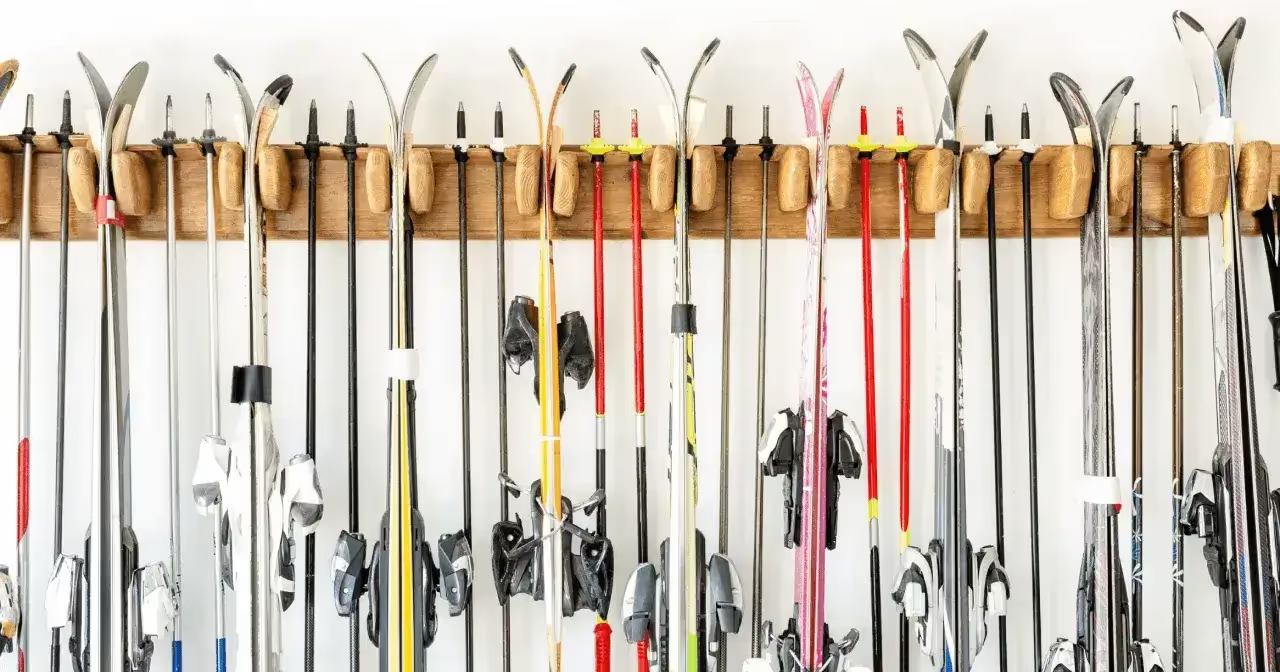
Garage Ski Storage: Loads, Materials, Failure Modes
Quick answer
Garage ski storage is a load problem before it is a shopping problem. Seven racks, each checked against its manufacturer's published rating, sorted by where the load goes: into the studs, onto the floor, or up into the joists — and the garage conditions that disqualify each.
Disclosure: MyCargoRacks.com is reader-supported. When you buy through links on our site, we may earn an affiliate commission at no extra cost to you. Learn more
Garage ski storage is not a shopping problem. It is a load problem. Skis, bindings, poles and wet winter gear add up quickly. Weigh your heaviest pair, multiply by the number of pairs you plan to store, then follow that load into the wall, floor or ceiling. The rack you pick decides which one, and each of those structures fails in a different way.
The forces are different. The mounting surfaces are different. The failure modes are different. So this guide sorts seven racks by where the load goes, checks each one against the rating its own manufacturer publishes, and then lists the garage conditions that rule each design out.
A note on the numbers: the capacities and prices below come from the manufacturers' own product pages, checked on September 15, 2026. They are based on manufacturer data, not our own measurement. Where I work through a load, I state the assumption in the sentence so you can rerun it with your own skis.
The three ways a garage carries ski weight
A garage ski rack sends weight to one of three structures. Wall racks load the studs. Freestanding racks load the floor. Ceiling racks load the joists. The right choice is the one whose structure your garage actually has, at the spacing and orientation the rack needs.
Wall-mount racks: the studs carry it
Most garage ski racks are wall-mounted, and they come in two shapes. Horizontal racks lay skis flat across two or more arms. Vertical racks hang skis upright by the bindings or the tips. Horizontal storage needs wall length roughly equal to your longest ski. Vertical storage needs height and very little width.
Here's why the fasteners matter more than the steel. Skis sit out from the wall on arms, so their weight acts on a lever. Assume four pairs at 15 pounds each (weigh yours; it takes ten seconds on a bathroom scale) sitting 8 inches out from the wall. That is 60 pounds on an 8-inch arm, or 480 inch-pounds of moment. The rack resists it by pulling on its top fasteners and pushing its bottom edge into the wall. If the upper fasteners are 4 inches above the lower bearing edge, the upper fastener group must resist roughly 480 ÷ 4 = 120 pounds of outward tension in this simplified model. The real load per screw depends on the rack's backplate stiffness, fastener spacing, wall condition and how evenly the rack bears against the wall. Make the backplate taller and that force drops. Push the skis farther out and it climbs.
That pull-out force is exactly the load drywall cannot hold. Gypsum is a compressed mineral core between two paper faces. Under a steady outward pull it crumbles around the anchor, a little at a time, until the anchor walks out. A wood stud holds a lag screw's threads in continuous fiber. That is the entire difference.
Freestanding racks: the floor carries it
Freestanding racks sit on the slab and hold skis upright. Nothing gets drilled, which makes them the default for renters, block walls, and walls that are already full. The trade is floor space and stability.
Here's why stability is the real specification. When skis stand upright in a floor rack, most of the weight sits well above the base. For a visual estimate, treat the ski mass as concentrated about 33 inches above the floor — roughly the middle of a 170 cm pair standing on its tails. On a 16-inch-deep base, that puts the ski load's theoretical tipping line at roughly 14 degrees of lean. The rack base, ski placement and any sideways shove change the real number, which is exactly why a narrow freestanding rack needs a protected, level location.
Ceiling racks: the joists carry it
Ceiling racks come in two forms. Fixed racks bolt to the joists and hold skis on arms a set distance below the ceiling. Pulley hoists lift skis up on a rope. Both move the load into the joists, and both free floor and wall space entirely. They also ask the most of the installer, because the only acceptable anchor is solid framing.
Seven garage ski racks, checked against their own specs
The table sorts each rack by load path first. "Rated load" is the manufacturer's published total; a dash means the manufacturer does not publish one. Prices are the maker's list price on September 15, 2026; they change, so check the maker's page before you buy.
| Rack | Load path | Capacity | Rated load | Material | Price |
|---|---|---|---|---|---|
| StoreYourBoard Snowbasin | Wall, vertical | 8 pairs | 200 lb (50 lb per fork) | Powder-coated steel | ~$102 |
| StoreYourBoard Solitude | Wall, adjustable | 10 pairs | 300 lb | Not published | ~$153 |
| Rocker Ski Rack Quad | Wall, horizontal | 4 pairs | — | Steel racks on hardwood board | ~$372–406 |
| Gravity Grabber OG | Wall, vertical | 1 pair or 1 board per unit | 20 lb per unit | Rubber-padded grip | ~$68 |
| StoreYourBoard Telluride | Freestanding | 4 pairs | — | Polycarbonate | ~$170 |
| CozyWinters Parabolic/Fat Ski Rack | Freestanding | 4 pairs | — | Polyurethane | ~$263 |
| StoreYourBoard Hi-Port 2 (Single) | Ceiling, fixed | 5 skis or 8 snowboards | 75 lb | Powder-coated steel | ~$110 |
1. StoreYourBoard Snowbasin — the most capacity for the price
Load path: Wall, vertical · Capacity: 8 pairs on 4 forks · Rated load: 200 lb total, 50 lb per fork · Price: ~$102
The Snowbasin is four solid steel forks, each 11.6 inches deep, holding two pairs apiece. It arrives assembled with two lag screws and is designed for studs 16 inches apart.
Read the rating the way it is written. The 50-pound-per-fork figure is not a license to concentrate the household's heaviest gear on one fork. Weigh the pairs you actually own, then distribute the load across the forks rather than treating the 200-pound total as a single-point rating.
When it fits: 16-inch-on-center studs and a mixed family quiver. When it does not: 24-inch stud spacing, because the mounting holes are laid out for 16.
2. StoreYourBoard Solitude — capacity with adjustable spacing
Load path: Wall, adjustable rail · Capacity: 10 pairs · Rated load: 300 lb · Price: ~$153
The Solitude is a 46-inch rail with movable attachments. StoreYourBoard calls its mounting approach an "infinity stud system", meaning the rail accepts fasteners at almost any stud location instead of fixed holes.
This is the right fix for the stud-spacing problem that rules out fixed-hole racks. A 46-inch rail crosses three studs at 16 inches on center or two at 24. More fasteners in more studs share the pull-out load, which is the number that actually limits a wall rack.
When it fits: larger households, and walls with non-standard or 24-inch framing. When it does not: a wall with less than about four feet of clear width.
3. Rocker Ski Rack Quad — made for rockered skis
Load path: Wall, horizontal · Capacity: 4 pairs · Rated load: not published · Price: ~$372–406
Rocker makes steel racks by hand in Ashland, Oregon. The Quad is four of them pre-mounted on a hardwood board, with mounting holes pre-drilled at 24 and 32 inches. Rocker says the design stores skis without altering their natural shape. Single racks start at ~$66–83, and each one includes a hanger for poles and accessories.
The pre-drilled board solves stud spacing a different way: 32 inches is two studs on a 16-inch wall, and 24 inches is two studs on a 24-inch wall. The missing load rating matters more. With no published number, your fasteners and your studs are the rating. Treat it the way you would treat any unrated shelf: lag screws into wood studs, and no leaning on it.
When it fits: rockered or twin-tip skis whose shape you want left alone, on a wall you are happy to look at. When it does not: a buyer who wants a manufacturer's number to plan against.
4. Gravity Grabber OG — one pair, tip-up, nothing to adjust
Load path: Wall, vertical · Capacity: one pair of skis or one snowboard per unit · Rated load: 20 lb per unit · Price: ~$68 (multi-packs available)
The Gravity Grabber is a single holder with a maximum opening of 1-7/8 inches and a gravity-locking design: the weight of the gear is what closes the grip. Each unit ships with six #8 screws. The maker says it holds skis and snowboards of any size and type.
Two numbers decide whether it suits you. The first is the 20-pound rating against the weight of your heaviest pair: weigh it, and if it lands in the high teens, the holder is working near its limit every day it hangs there. The second is the supplied mounting hardware. Follow Gravity Grabber's installation instructions exactly, and do not assume the supplied screws can safely carry a heavy ski through drywall alone. If the mounting location is not solid framing, use the manufacturer's approved mounting board or adapter system.
When it fits: a few pairs, mixed with snowboards, in narrow wall gaps. When it does not: a heavy freeride quiver close to the rating.
5. StoreYourBoard Telluride — freestanding, no drill into the wall
Load path: Freestanding · Capacity: 4 pairs, tips up to 140 mm wide · Rated load: not published · Price: ~$170
The Telluride is a polycarbonate floor rack, 15 inches wide and 12 inches tall, made in Virginia. It includes four ski straps and assembles with a drill and a screwdriver.
Polycarbonate is generally a tougher choice than many commodity plastics in a cold garage. That does not make every polycarbonate rack indestructible, and it does not tell you how a specific molded part will behave after years of UV exposure, impacts and repeated loading. The 12-inch height is the stability story: the rack itself is low, so almost all of the tipping moment comes from the skis standing in it. Load it evenly.
When it fits: renters and block walls, with up to 140 mm tips. When it does not: wide powder skis over 140 mm, or a spot where car doors swing.
6. CozyWinters Parabolic/Fat Ski Rack — the heavier freestanding option
Load path: Freestanding · Capacity: 4 pairs (6 on the XL) · Rated load: not published · Price: ~$263 (XL ~$331)
CozyWinters molds this rack from heavy-duty polyurethane. It measures 23.75 × 15.75 × 17 inches and weighs 14 pounds; the six-pair XL is 34.5 inches long and 21 pounds.
Mass in the base is useful here. A heavier base lowers the combined center of mass of the rack and skis, which buys back some of the tipping margin that tall skis take away. The 15.75-inch depth is the dimension that sets that margin, as the freestanding section above worked through.
When it fits: a permanent spot on the slab with fat skis. When it does not: a one-car garage where every square foot of floor is spoken for.
7. StoreYourBoard Hi-Port 2 (Single) — the ceiling, done with fixed posts
Load path: Ceiling, fixed · Capacity: 5 skis or 8 snowboards · Rated load: 75 lb · Price: ~$110 (Double: 150 lb, 10 skis, ~$136)
The Hi-Port 2 is two powder-coated steel posts, each bolted into a ceiling joist, with padded arms that adjust from 10 to 18 inches below the ceiling. The base rotates 90 degrees so it can line up with joists running either direction. The posts accept any joist spacing.
It is a fixed rack, not a pulley hoist. You lift the skis up to it. That is simpler and has no rope to wear out, but it only suits a ceiling you can reach safely from a step stool. The rotating base helps the posts align with joists regardless of joist direction. That makes correct attachment easier, but it does not remove the need to locate solid framing and follow the manufacturer's mounting instructions.
When it fits: full walls and floors, reachable ceilings, and joists you can locate. When it does not: trusses you are not permitted to load, or ceilings too high to reach without a ladder.
When NOT to use each type
Each design class wins somewhere. Each also has conditions where it will fail, and when that happens the rack is rarely the cause. The choice is.
When NOT to use a wall-mount rack
- Your studs do not line up with the rack's mounting holes. A fixed-hole rack drilled for 16-inch spacing on a 24-inch wall ends up with one fastener in wood and one in gypsum. Every bit of outward pull then goes through a single screw. Choose a rail system, or mount a board across two studs first.
- Your garage has light-gauge steel studs. Do not assume a wall rack designed for wood studs can be transferred directly to light-gauge steel studs with different screws. Stud gauge, wall build-up, rack load and the fastening system all matter. Use a rack and mounting method explicitly approved for steel-stud construction, or install a properly designed backing system that transfers the load to suitable framing.
- Your wall is hollow concrete block. Do not treat hollow block like solid poured concrete. A wall rack pulls outward as well as downward, and hollow block can fail at the face shell or around an anchor. Use an anchor system rated by its manufacturer for the block type and the combined load, or choose a freestanding rack if you cannot verify the wall construction.
When NOT to use a freestanding rack
- A car door swings into the spot. Every impact shoves the loaded rack sideways, and the skis' high center of mass turns the shove into a tipping moment. Repeated bumps walk the rack out of position until one lands when the load is uneven.
- The slab slopes under the rack. Garage floors are often pitched toward the door. Half an inch of drop across a 16-inch-deep base is already about 1.8 degrees of lean before anything is loaded. That comes straight off the tipping margin.
- The floor space rotates with the seasons. If the snowblower and the lawnmower take turns in that corner, the rack gets dragged around every few months. Joints that get racked and re-seated loosen faster than joints that stay put.
When NOT to use a ceiling rack or hoist
- You cannot find the joists, or your garage has engineered roof trusses. A ceiling rack in drywall fails by pulling straight down through the board. Do not treat an engineered roof truss like an ordinary ceiling joist. A truss is a designed structure: its chords and web members carry forces in a specific pattern, and adding a concentrated hanging load where the truss was not designed for it can create stresses the original roof system never saw. If your garage has trusses rather than conventional joists, do not mount a ski rack until the truss manufacturer, building plans, or a qualified structural professional confirms that location and load are acceptable.
- The mount loads only one narrow edge of a joist, or sits far off its centerline. A joist is strongest when a load is applied through its depth, not when the mount tries to rotate it sideways. Keep the mounting hardware centered over the joist where possible. If the rack geometry requires a wider mounting pattern, fasten a properly sized cross-member across multiple joists and mount the rack to that — not to drywall.
- It is a rope hoist whose rope has been left in direct sunlight, shows fraying, glazing, stiffness, flattening or color fade, or has an unknown service history. Rope is a wear item. Inspect the rope, pulleys, hooks and attachment points every season, and replace any component showing damage before loading skis overhead.
Should skis be stored vertically or horizontally?
Either orientation is fine for the ski. What damages skis in storage is a sustained load that bends them against their camber, clamps their edges, or traps moisture against the base. Choose the orientation your wall space allows, then make sure the contact points are padded and the ski keeps its natural shape.
Horizontal storage supports the ski at two points along its length. Horizontal racks should support skis at padded contact points that do not force the ski away from its natural camber. Arm spacing matters mainly because very close supports can create awkward point loading or leave long, easy-to-bump overhangs in a crowded garage — not because a normally supported ski will sag under its own weight. Horizontal racks also need wall length: roughly the length of your longest ski.
Vertical storage hangs the ski by its tip, tail or bindings. A hanging ski is loaded in light tension along its length, which does nothing to its camber. The concerns are practical. Skis stored tail-down on a wet floor wick water into the tail. Straps left cinched for months hold melt-water against the base.
Can you build a garage ski rack yourself?
Yes, you can build a garage ski rack, but treat it as a wall-mounted shelf system — not as a few dowels screwed into whatever looks solid. A 2×4 cleat screwed into at least two studs, with pairs of hardwood dowels or padded pegs angled slightly upward, holds skis horizontally or by the bindings. What matters is fastener selection, stud engagement, peg length, load distribution and padded contact points — not the lumber.
Four rules keep a homemade rack from becoming a drywall repair:
- Screw the cleat into studs, at least two of them. Use structural wood screws or lag screws long enough to go well into the stud, not just through the drywall.
- Angle the pegs up by a few degrees. Gravity then pulls the skis toward the wall instead of off the ends of the pegs.
- Space the pegs for your widest ski. A 140 mm powder ski is about 5.5 inches wide at the tip, so leave at least 6 inches between pegs if you own one.
- Pad every contact point. Pipe insulation or rubber tubing over the dowels keeps wood and screws off your edges and bases.
Run the lever check from the wall-mount section on your own design. The longer the pegs, the harder the top screws are pulled. Keep the pegs no longer than the skis need.
Materials: what lasts in a cold garage
A garage is a cold, damp, salt-exposed room. Materials behave differently there than they do in a heated house.
- Powder-coated steel is the default for good reason. Steel supplies the stiffness, and the powder coat keeps road salt and condensation off it. Chips in the coating are where rust starts, so touch them up.
- Polycarbonate and polyurethane are commonly used where a garage rack needs more impact resistance than a basic commodity plastic provides. Material name alone is not a durability rating: resin grade, wall thickness, molding quality, UV exposure and repeated loading all affect how a specific part lasts.
- Any plastic load-bearing arm or bracket is an inspection item. If it shows cracking, whitening around stressed areas, deformation, or UV damage, replace the part rather than assuming the remaining material retains its original strength.
- Rubber and foam padding compresses and hardens with time, cold and UV. Once a pad has flattened enough that metal touches the ski, replace it. Hardware-store rubber tubing works.
The right garage ski rack is the one your structure can carry
There is no best garage ski rack. There are three load paths, each with its own mounting rule and its own way of failing. A wall rack wins on space and depends completely on stud placement. A freestanding rack wins on installation and pays for it in floor space and stability. A ceiling rack wins on real estate and demands joists and careful mounting.
Start with your garage: stud spacing, wall material, floor slope, joist direction. Then pick the rack whose load path your garage can actually support, and check its published rating against your heaviest pairs. The products are simple. The load math is real. For the other half of the job, getting skis to the mountain, see how ski racks work, whether a magnetic ski rack suits your car, and how ski racks compare with cargo boxes. If the trip starts on a sled instead, the mounting problem changes again: see snowmobile ski and snowboard racks.
Frequently Asked Questions

Related articles
Keep reading
Deals Worth the Splurge
Hand-picked price drops on the racks and carriers we actually recommend. Updated weekly.
Shop today's deals →Newsletter
Get the best rack deals in your inbox
Weekly picks, price drops, and honest reviews. No spam.
Disclosure: MyCargoRacks.com is reader-supported. When you buy through links on our site, we may earn an affiliate commission at no extra cost to you. Learn more