Usamos cookies e análises para melhorar sua experiência. Você pode recusar a qualquer momento.

Quick answer
Curious about magnetic ski racks? Find out all you need to know about these innovative racks for easy and efficient ski transportation.
Aviso: MyCargoRacks.com é financiado por leitores. Quando você compra através de links em nosso site, podemos receber uma comissão de afiliado sem custo adicional para você. Saiba mais
Escrito originalmente por Jason Majewski em inglês, traduzido e adaptado para relevância local. Conteúdo pesquisado e localizado para leitores de pt-PT.
Magnetic ski racks are one of those products that people either love unconditionally or refuse to trust at all. The divide usually comes down to whether someone understands the physics involved or whether they're imagining their $800 skis flying off the roof at 70 mph. Both reactions are understandable — the technology is legitimately impressive, but the failure modes are real and worth understanding before you buy.
As an engineer, I find magnetic racks fascinating because they solve a genuine problem — mounting skis to a vehicle without any permanent rack hardware — using basic electromagnetic principles that have been reliable in industrial applications for decades. The question isn't whether magnets can hold skis to a car roof. The question is whether a specific product, at a specific price point, holds them safely under real-world driving conditions. Let me walk through the engineering, the products, and the honest limitations.
Every magnetic ski rack on the market uses neodymium rare-earth magnets — specifically, neodymium-iron-boron (NdFeB) magnets. These are the strongest permanent magnets commercially available.
A single neodymium magnet the size of a hockey puck can generate 100+ pounds of pull force against a flat steel surface.
Pull force is the maximum force required to separate the magnet from a flat steel plate when pulled straight away (perpendicular). This is the number manufacturers advertise — 200 pounds, 300 pounds, etc. It's a real measurement, but it's also the best-case scenario.
Here's what reduces effective pull force in real-world use:
A rack with a stated pull force of 200 pounds might deliver 80–120 pounds of effective holding force on a real car roof, accounting for paint gap, curvature, and shear angles. Two pairs of skis with bindings weigh roughly 25–40 pounds. The aerodynamic lift and drag forces at 70 mph on a pair of skis might generate 15–30 pounds of force, depending on ski profile and wind angle. So the math works — there's a comfortable safety margin in most conditions.
Where it stops working: sudden impacts (potholes, speed bumps at speed), crosswinds that change the load direction abruptly, and dirty or wet surfaces that reduce the friction component of the magnet's holding ability. The magnets don't "fail" in these scenarios — they can be momentarily overcome by forces that exceed their effective holding capacity.
To be fair to both categories, here's how they compare on the metrics that actually matter:
Magnetic racks: under 60 seconds. Place them on the roof, load skis, drive. Remove just as fast. No tools, no clips, no crossbars. This is the primary advantage, and it's genuinely significant for people who don't ski every weekend and don't want permanent roof hardware.
Traditional racks: require crossbars (permanent or semi-permanent installation), plus the ski carrier that mounts to the crossbars. Initial setup takes 30–60 minutes. After that, loading skis is fast, but the crossbars stay on your vehicle all season, adding wind noise and drag even when you're not carrying skis. For a detailed explanation of how traditional crossbar-mounted racks work, see our expert guide to ski rack mechanisms.
Magnetic racks have essentially zero theft resistance. Anyone can pull the rack off your car — it's held on by magnets. Your skis are completely exposed and unsecured against theft.
Traditional racks can include keyed locks that secure skis to the carrier and the carrier to the crossbar. Not theft-proof, but theft-resistant.
Magnetic racks work on any vehicle with a steel roof. No fit guide needed, no model-specific hardware. But they fail entirely on aluminum, fiberglass, or carbon fiber roofs.
Traditional racks work on any vehicle with compatible crossbars, regardless of roof material. The crossbar system handles the compatibility question, not the ski carrier.
Most magnetic racks carry 2–4 pairs of skis or 1–2 snowboards. Traditional racks can carry 4–6 pairs of skis or 2–4 snowboards depending on the model.
Shark Racks has been the dominant brand in magnetic ski carriers for years, and they've earned that position through solid engineering. Their standard model uses four neodymium magnet assemblies with a total rated pull force exceeding 300 pounds. The magnets are housed in rubber-coated shells that protect your paint and conform slightly to roof curvature.
What makes it work: The magnet assemblies are connected by a rigid aluminum crossbar, which distributes the load across all four magnets simultaneously. This means a side gust doesn't load one magnet disproportionately — the crossbar frame resists the rotational force. It's a simple but effective structural decision. Carries up to 4 pairs of skis or 2 snowboards.
What to know: Price is $200–$280 depending on configuration. The rubber coating will pick up road grit over time — clean the magnet faces and your roof before each use to maintain full contact. Speed rating is typically 80 mph, but I'd stay under 70 mph as a practical matter, especially in crosswinds.
BrightLines offers a magnetic ski rack in the $80–$120 range that uses a similar neodymium magnet design but with a simpler frame. Two magnet pods connected by a ski cradle assembly. Rated for 2 pairs of skis.
What makes it work: For light loads (two pairs of skis or one snowboard), the physics work fine even with fewer magnet pods. The pull force is still well above what the wind loads demand for two pairs of skis at highway speed.
What to know: The frame flexes more than the Shark Racks model under load. With two heavy pairs of downhill skis plus bindings, I'd be more conservative on speed — 60 mph max. The rubber pad quality is adequate but not premium. Inspect for wear and replace if you see cracking. This is a fair product for the price, not a bargain substitute for the Shark Racks unit.
Shark Racks offers a snowboard-specific configuration with wider cradle spacing to accommodate snowboard width and binding protrusion. The magnet assemblies are identical, but the crossbar and cradle geometry are optimized for the wider, asymmetric load profile of snowboards.
Engineering note: Snowboards create more aerodynamic lift than skis because of their wider surface area. At 65 mph, a snowboard on a roof rack experiences measurable upward force. The magnet system needs to overcome this lift in addition to drag. The Shark Racks system handles this within its safety margin, but I'd reduce my speed limit to 65 mph with snowboards versus 70 mph with skis.
I want to be direct about the scenarios where I'd tell you to skip the magnetic option:
For understanding why traditional ski rack and cargo box systems cost what they do and what you get for that investment, our pricing analysis provides useful context.
Understanding why each system works, and where each one reaches its limits, is what keeps your gear on the roof and out of the highway.
Magnetic ski racks work. The physics is sound, the neodymium magnet technology is mature, and products like Shark Racks have established a reliable track record. The key is understanding that they work within defined limits — steel roofs only, moderate speeds, moderate loads, clean contact surfaces. If your use case fits within those parameters, a magnetic rack is a genuinely elegant solution that eliminates the need for permanent crossbars and all the noise, drag, and cost that come with them.
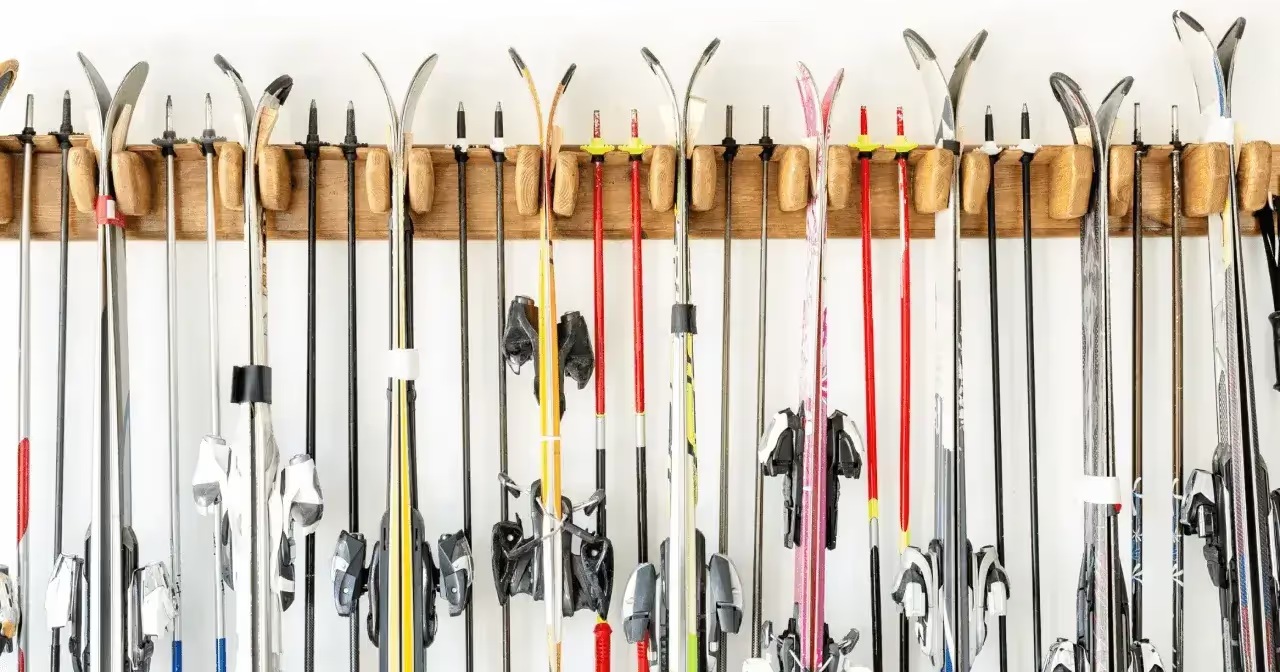
If your use case exceeds those parameters — aluminum roof, heavy loads, high-speed mountain highway driving — a traditional crossbar-mounted system is the safer engineering choice. There's no shame in choosing the more robust option. For garage storage of your skis and boards between trips, our garage rack guide covers the best wall-mount and freestanding options.
Related articles
Hand-picked price drops on the racks and carriers we actually recommend. Updated weekly.
Shop today's deals →Newsletter
Get the best rack deals in your inbox
Weekly picks, price drops, and honest reviews. No spam.
Aviso: MyCargoRacks.com é financiado por leitores. Quando você compra através de links em nosso site, podemos receber uma comissão de afiliado sem custo adicional para você. Saiba mais